Is CBD Legal in Europe? Your Complete Guide for 2026
The legal status of CBD in Europe still raises plenty of questions. While cannabidiol is broadly permitted within the European Union, national laws have significant differences from one country to the next. Whether you are buying CBD flowers or oil, this guide covers the CBD regulatory landscape across Europe, THC limits, the Novel Food framework, and what you need to know about buying or travelling with CBD.
The common European framework
The CJEU ruling (2020)
The Kanavape ruling by the Court of Justice of the European Union in August 2026 was a game-changer. The Court ruled that CBD is not a narcotic and that a member state cannot ban the sale of CBD legally produced in another member state.
THC limit for industrial hemp
The EU permits industrial hemp cultivation with a THC content of no more than 0.3% (CAP cap in force from 1 August 2026; previously 0.2%). Authorised varieties are listed in the Common Catalogue of Varieties of Agricultural Plant Species.
Novel Food regulation
Ingested CBD is classified as "novel food" under EU Regulation 2015/2283. This means CBD products intended for consumption in principle require prior EFSA authorisation, which is currently under evaluation. Products sold as cosmetics, aromatic oils, or hemp flowers follow different regulatory regimes.
For CBD basics, check out our complete guide to CBD.
Regulations by country
France
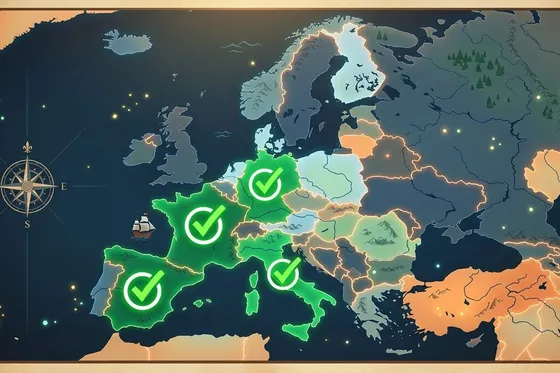
The Arrêté of 30 August 2026 authorises the sale of CBD products with THC below 0.3% in the finished product. The Conseil d'État, with its decision of 29 August 2026, annulled the ban on the sale of hemp flowers and leaves with low THC, confirming that CBD is not a narcotic. Oils, flowers, hash, extracts, e-liquids, and seeds are all available.
Germany
Germany takes a relatively open approach. With the Cannabisgesetz (CanG) in force since 1 August 2026, recreational cannabis use has been legalised for adults (within set limits, e.g. max 25 g of public possession, 50 g at home, 3 personal plants; Cannabis Social Clubs from August 2026). For CBD from industrial hemp, the EU CAP cap of 0.3% THC applies. The German Narcotics Act (BtMG) explicitly excludes CBD from controlled substances.
Italy
Italy's regulatory framework is complex and evolving. The Law 242/2016 governs industrial hemp cultivation (THC <0.2% with tolerance up to 0.6%). The Security Decree 2024 introduced restrictions on inflorescences and low-THC derivatives; subsequent rulings of the Italian Supreme Court (Cassazione) have however limited their practical application. The framework is subject to differing interpretations across legislation, case law, and industry practice — it is advisable to verify the applicable rules at the time of purchase.
A pivotal moment for CBD legality in Europe came in August 2026, when the European Court of Justice ruled in the Kanavape case. A French entrepreneur had been prosecuted for importing CBD e-liquid from the Czech Republic. The Court declared that CBD is not a narcotic under the 1961 UN Single Convention on Narcotic Drugs and that France could not restrict the free movement of lawfully produced CBD goods. This landmark ruling reshaped the legal landscape across Europe and opened the door for legal CBD trade in many member states that had previously maintained restrictive positions.
Spain
In Spain it is necessary to clearly distinguish between topical CBD (cosmetics, creams, balms with <0.2% THC), regulated by EC Regulation 1223/2009 on cosmetic products, and oral CBD (ingestible oils, gummies) which remains in a regulatory grey area. AEMPS applies the EU Novel Food regime (Reg. EU 2015/2283) to ingestible CBD, with authorisation pending. Most oral products are in fact sold as "external use". The 0.2% THC threshold refers to industrial hemp and does not in itself guarantee the lawfulness of oral consumption.
Switzerland
Though not an EU member, Switzerland is a major CBD market in Europe. The permitted THC threshold is 1% -- the highest on the continent.
Netherlands
Dutch regulations on finished CBD products tend to set a very low THC level (around 0.05%), among the strictest in Europe.
Austria
Aligned with the EU CAP cap: CBD products with THC below 0.3% are commonly available. The Austrian CBD market is well-developed.
Portugal
CBD products from industrial hemp follow the EU cap; cultivation rules reflect the national transposition with thresholds of 0.2-0.3%.
Summary table (as of 2026)
| Country | Industrial hemp THC | CBD flowers | CBD oils | Regulatory framework notes |
|---|---|---|---|---|
| France | 0.3% | Available (Conseil d'État 2022) | Available | Arrêté 2021 + Conseil d'État 2022 |
| Germany | 0.3% | Available | Available | CanG 2024 + EU CAP cap |
| Italy | 0.2% (tolerance 0.6%) | Available, framework evolving | Available | Law 242/2016 + Security Decree 2024 + Cassazione |
| Spain | 0.2% (industrial) | Grey area | Topical available; oral Novel Food pending | AEMPS, topical vs oral distinction |
| Switzerland | 1.0% | Available | Available | Outside EU |
| Netherlands | ~0.05% | Available (strict regime) | Available | Strict national rules |
| Austria | 0.3% | Available | Available | Aligned with EU CAP cap |
| Portugal | 0.2-0.3% | Available | Available | National transposition |
Indicative table as of 2026. The framework is evolving: always check the applicable rules at the time of purchase.
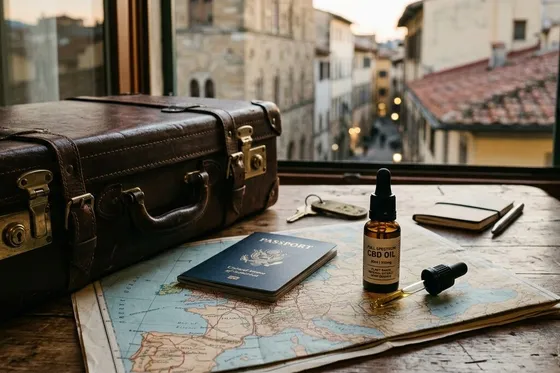
Elena, 33, a freelance translator based in Lisbon, travels frequently between Portugal, France and Germany for work. She discovered the complexity of CBD regulations the hard way when a customs officer at a French airport questioned the CBD oil in her hand luggage. Since then, she always carries a printed copy of the product's lab analysis showing the THC content below 0.2%, along with the original receipt. She has not had a problem since, but notes that each border crossing still comes with a moment of uncertainty that would not exist with any other wellness product.
Travelling with CBD across Europe
Essential precautions
- Check the destination country's laws before you leave
- Keep the original packaging with clear product labelling
- Bring the Certificate of Analysis (COA) for your product
- Go for 0% THC products (broad spectrum or isolate) to minimise any risk
- Keep quantities reasonable -- large amounts may attract attention at customs
By plane
Liquid CBD products (oils, e-liquids) must follow standard carry-on liquid rules (containers under 100 ml in a clear plastic bag).
By car
At intra-European borders (Schengen area), checks are rare but possible. Keep products in their original packaging with the COA handy.
CBD and driving
CBD itself does not impair driving ability. However, some full spectrum products contain trace amounts of THC that could theoretically show up on a test. If you will be driving, go for broad spectrum products (0% THC).
Legal CBD products in Europe
Products available legally in most European countries:
- CBD oils: widely permitted as cosmetic or aromatic products
- CBD flowers: legal in most countries under THC conditions
- CBD hash: legal in several countries (France, Italy, Switzerland)
- CBD extracts: legal (wax, crumble, resin) under THC conditions
- CBD e-liquids: legal, subject to vaping regulations (TPD)
- Hemp seeds: legal everywhere as a food product
Discover CBD products at JustBob - 15% off
Check out our article on CBD vs THC, the cannabis light guide, and our article on legal hash to better understand the legal framework of hemp products.
CBD Market in Europe: Rules and Regulations by Country
The CBD market in Europe has grown into one of the largest in the world, but the rules and regulations differ from country to country. France, Germany, and Austria allow CBD products from industrial hemp with THC up to 0.3% (EU CAP cap). Italy refers to the 0.2% threshold (with 0.6% tolerance) for industrial hemp, with an evolving framework for finished products. Poland sets some of the stricter restrictions: CBD in cosmetics is permitted, while CBD oils are treated as food supplements with tighter labelling rules. The Czech Republic has historically been more permissive, with a long tradition of hemp-based products in wellness and food.
Free CBD Movement, Hemp and Restrictions to Know
Inside the EU single market, CBD products compliant with one member state's regulations can generally circulate in others, although some countries enforce specific restrictions on cannabis-derived cosmetics, food products, and flowers. Switzerland, outside the EU, allows CBD with THC up to 1% and has a very active retail scene. When buying CBD across borders, check local rules for hemp, THC thresholds, and product categories (cosmetics vs food vs inhalable).
FAQ -- CBD Legal in Europe
1. What is the regulatory status of CBD across EU countries?
CBD is regulated unevenly across EU countries: conditions vary (THC thresholds, permitted forms, Novel Food regime). It is always advisable to verify the applicable rules in the country of interest at the time of purchase.
2. Can you get in trouble for having CBD in Europe?
Generally no, if the product meets the country's THC limits and has clear labelling. However, CBD flowers can look identical to cannabis, which may trigger additional checks.
Here is a scientific fact worth noting: a growing body of research confirms that CBD has no abuse potential and does not cause intoxication. The World Health Organization's Expert Committee on Drug Dependence reviewed the evidence and concluded that CBD exhibits no effects indicative of abuse or dependence potential. This assessment was instrumental in shaping the CJEU's 2020 ruling that CBD should not be classified as a narcotic: a decision that underpins the entire European legal framework for CBD today.
3. Does Novel Food regulation ban CBD?
No. It requires an authorisation process for CBD products marketed as food. Products sold as cosmetics or aromatics are not affected by this specific regulation.
4. Is CBD legal for minors?
Legislation varies by country, but most responsible retailers only sell CBD to adults (18 and over).
5. Where can you buy CBD that complies with European regulations?
Go for specialised shops that publish lab reports for their products. At JustBob, all products comply with European regulations, with code PROMO15 for 15% off.
For more, check out our CBD oil guide and our CBD flowers guide.